Organization art project grant
The Art Project Grant Program provides funding up to $5,000 for organizations throughout the Arrowhead Region. This grant is intended to support relevant, meaningful arts activities that have value to the organization and significant community impact. Applicants may propose general art projects or arts education projects.
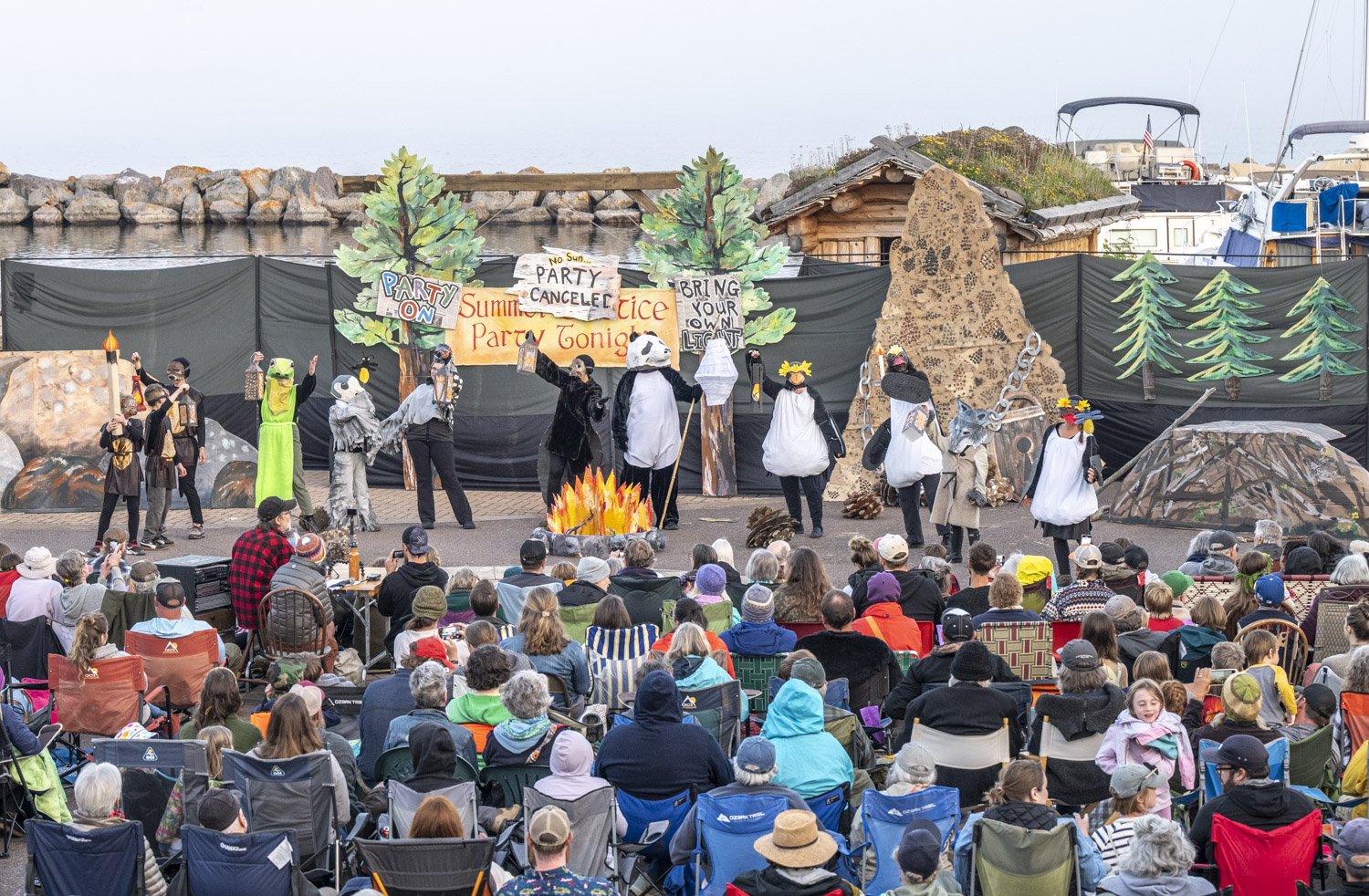
Good Harbor Hill Players
Art Project Grant Recipient
Maximum Award: $5,000
proposed projects
May include, but are not limited to, the creation, performance, exhibition, or publishing of artistic works; presenting arts events, workshops, or festivals; participating in non-academic learning opportunities; and/or offering non-academic arts education opportunities.
Important dates
Application Opens: February 2, 2026
Deadline: March 15, 2026, before 11:59 pm
Grant Period Start Date: July 1, 2026
Grant Period End Date: June 30, 2027
Panel Review Weeks: April 20 – 30, 2026
Award Notification Date: Week of May 21, 2026
Qualified applicants should apply regardless of their race, color, national origin, ancestry, religion, age, gender, sexual orientation, gender identity, marital or family status, pregnancy, use of a support animal, educational background, or status as a qualified individual with a disability or protected veteran. Individuals who are Black, Indigenous, People of Color, people with disabilities, people age 65 and older, military veterans, and/or individuals who identify as lesbian, gay, bisexual, transgender, queer, intersex, asexual, agender, Two-Spirit (LGBTQIA2+) are encouraged to apply.
For any ADA accommodation requests throughout the application process, please reach out to info@aracouncil.org for support.
ELIGIBILITY
-
To apply for an Art Project Grant, an organization must meet structural requirements.
Eligible applicants must meet one of the following structural criteria:
A 501(c)(3) tax-exempt arts organization
A 501(c)(3) tax-exempt non-arts organization that regularly offers arts programming
A unit of state, local, or tribal government
An arts group without 501(c)(3) status applying with a Minnesota tax-exempt or public fiscal sponsor, separately tracked and reported.
If the applicant is applying with a fiscal sponsor, the following are the requirements:
The fiscal sponsor must have been operating for at least one full fiscal year.
Fiscal sponsors based outside of Minnesota may not receive sponsor fees from grant funds.
The fiscal sponsor does not itself have to be an arts organization; however, the fiscal sponsor must have a mission that aligns with the proposed project and sponsored organization.
See Fiscal Sponsor Guidelines for more information.
Note: A fiscal sponsor may apply for its own Operating Support grant and also sponsor multiple applications within a grant program, as long as each application is a distinct, different project with all funding separately tracked and reported.
-
For-profit businesses, including those registered as LLCs, C-Corps, or S-Corps, are not eligible, regardless of fiscal sponsorship.
Organizations that receive Operating Support from the Minnesota State Arts Board for the same fiscal year or grant period.
Organizations that receive direct appropriations from the Clean Water, Land, and Legacy Amendment.
Organizations that receive direct funding from the State of Minnesota are ineligible to apply to all ARAC Grant Programs.
Note that this rule does not apply to fiscal sponsors.
-
Application must have arts and/or culture-bearing as the project’s primary focus.
Applicant must be eighteen (18) years of age or older and be a U.S. citizen or have permanent resident status.
Organizations must be based in Minnesota, as determined by their voting address and/or the payment of Federal, State, and local taxes.
Organizations must be located in ARAC’s service region consisting of the following seven (7) counties: Aitkin, Carlton, Cook, Itasca, Koochiching, Lake, and St. Louis, and/or one of the following four (4) Tribal Nations: Bois Forte Band of Chippewa, Fond du Lac Band of Lake Superior Chippewa, Grand Portage Band of Lake Superior Chippewa, and Leech Lake Band of Ojibwe (District I).
Organization must have been a resident of ARAC’s service region for at least six (6) months prior to the deadline of this application, as well as throughout the duration of the project.
NEW FY26! Proposed project and reporting must be completed within the specified grant period date range, typically over a 12-24 month duration.
See “Important Dates” within the Grant Program Guidelines for the applicable project date range based on the program of interest.
NEW FY26! While applicants may technically apply to multiple grant programs, only one (1) grant may be active at a time. If you are a returning applicant and have an open grant with ARAC, you must complete all funded activities and submit a final report through the Grant Portal before you can receive new funding.
Does not apply to ARAC Operating Support grantees or first-time applicants.
Reach out to info@aracouncil.org with any general questions, or grants@aracouncil.org if you have a current open grant project and wish to apply.
-
Project funds may not be used for any costs incurred before the grant period start date or after the end date.
Funds may not be used for events not available/open to the public.
Project may not require artists to pay an unreasonable entry fee in order to sell, exhibit, perform, publish, or otherwise participate.
Project may not be primarily intended to raise funds for an organization, charity, or cause, or to start or build an endowment.
Applicants may not be a current member of the ARAC staff, or a member of their immediate family. (Immediate family is defined as: spouse, domestic partner, parent, child, child’s spouse, brother, brother’s spouse, sister, or sister’s spouse.)
Individuals/organizations associated with a proposed project cannot apply for multiple grants to fund the same project, regardless of the role within the scope of work or artistic production.
Returning applicants must have filed satisfactory final reports through the Grant Portal for all prior ARAC-funded projects.
All applicants are required to maintain complete records relating to the receipt and expenditure of the grant funds for at least three years beyond the end date of the grant period. Your records may be audited or inspected by ARAC staff at any time after reasonable notification during the grant period and for three years following the completion of your project.
Applicants may not be in violation of any past contractual agreement with ARAC, such as an overdue Final Report from a previous ARAC grant.
Applicants must file a Final Report in alignment with the program requirements. Failure to report may jeopardize any future grants being received by the applicant from the MN State Arts Board (MSAB) or any other Regional Arts Councils (RACs). Incomplete reporting could result in the applicant being required to repay grant funds and/or being subject to further investigation of potentially fraudulent activity.
Applicants must not have failed to return grant funds to ARAC after having any ARAC grant contracts/agreements terminated or funding revoked.
-
Activities that take place outside the state of Minnesota.
Travel/Relocation outside the state of Minnesota.
To cover purchases made prior to the program’s earliest start date.
Activities that are principally recreational, therapeutic, or rehabilitative.
Classes, workshops, or projects relating to or resulting in academic credit, tuition for academic coursework, teaching licensure, or continuing education requirements (CEUs) to retain teaching licensure, or that replace discontinued activities that were formerly supported by state funds.
Creating or distributing new grants, prizes, or monetary awards to others.
However, providing free access, such as non-competitive scholarships for project participation, stipends, reduced rates, or complimentary tickets, is allowed.
Expenses associated with the running of a registered for-profit business, including but not limited to LLC, C-Corp, S-Corp, etc.
For rent, lease, or mortgage payments for space the applicant uses on an ongoing basis (i.e., home, studio, office space, storage, etc).
However, it is allowable to lease or rent space that is necessary for the proposed project (e.g., for performance, production, exhibition, etc.), so long as it is not routinely occupied by the applicant.
Capital improvements or purchases of permanent equipment.
Unless the capital improvement is for ADA Accessibility.
If applicable, there are no financial restrictions on the requested amount.
Marketing-related expenses totalling more than 50% of the total requested amount.
I.e. $2,500 is the maximum allowable marketing request of a $5,000 grant program for organizations.
Activities for the exclusive benefit of an organization’s members, unless they pertain to accessibility for current or potential employees (installing door openers and handrails, widening bathroom doors in employee areas, etc).
Contributions to any political party, organization, action committee, or any person who holds, or is a candidate for, elected office.
Lobbying activities, and/or activities in connection with any political campaign or referendum.
Activities that involve the religious socialization or proselytization of the audience or participants.
For any activity that violates federal, state, or local laws, ordinances, or policies, including copyright law.
Contingency funds for any amount are ineligible for funding.
The explicit use of Artificial Intelligence (AI) for the proposal and artwork is prohibited. Funds may not be used for AI products or generation. AI-generated work samples are prohibited.
Please see the AI Usage section for more information.
This is not a complete list. If you have any questions on eligibility, please contact info@aracouncil.org.
GenEral Requirements for all grants
-
Grant proposals should not create barriers to or prevent participation for individuals on the basis of race, color, national origin, disability, age, or sex. Individuals and organizations receiving ARAC funding will not discriminate based on the grounds or basis of, but not limited to, the following:
Race, color, or national origin (including limited English proficiency), in accordance with Title VI of the Civil Rights Act of 1964.
Disability, in accordance with Section 504 of the Rehabilitation Act of 1973 and the Americans with Disabilities Act of 1990, as amended (ADA).
Age, in accordance with the Age Discrimination Act of 1975.
Sex, in any education program or activity, in accordance with Title IX of the Education Amendments of 1972.
-
In accordance with the Americans with Disabilities Act, all grant-funded activities must be made accessible to provide equal opportunity for individuals with disabilities to participate.
This includes all grant award activities but is not limited to activities such as public performances, workshops, or other arts learning opportunities, publications, websites, and other multimedia projects.
All award recipients are legally required to provide reasonable and necessary accommodations for people with disabilities. Be mindful that audiences, visitors, artists, performers, teaching artists, students, staff, and volunteers all include individuals with disabilities.
Accessibility Reference Resources
-
If awarded, grantees must acknowledge ARAC and provide credit towards the funding source of the Grant Award. This includes but is not limited to online, in-print, and in-person whenever promoting the project. Neglecting to do so could result in the return of grant funds.
Refer to and abide by the ARAC Acknowledgement Guidelines for more on the language and logos to use, and reach out to info@aracouncil.org with any questions.
-
If awarded and a significant project change arises, grantees must seek permission in writing from ARAC before making any alterations to the proposed activity.
Changes could include, but are not limited to, vendor/partner updates, reporting extension requests, and other unforeseen circumstances resulting in a change in the scope of work originally proposed
Please submit requests through the project change request form.
-
Project funds cannot be used to generate artwork or other creative materials through artificial intelligence tools. Work samples that are submitted with the grant application must be created by the applicant and may not be AI-generated. Staff reserve the right to flag applications when work samples appear to be AI-generated. Applicants are responsible for ensuring all submitted materials reflect their own creative practice and original work.
Technically, applicants may use AI tools for limited administrative support when preparing written portions of the application. This includes help with grammar, structure, or clarity. Even so, we strongly discourage relying on AI to generate narrative content.
Proposals that depend heavily on AI often lack a distinct creative voice and may not address the criteria as thoroughly as required. Reviewers tend to score these applications lower because AI responses cannot fully reflect an artist’s intentions or lived experiences. Instead of AI, we recommend reaching out for Grant Advisement with ARAC’s team.
arts education opportunity
-
Projects with Arts Education components are encouraged to apply. An arts education distinction will have no positive or negative bearing on the scoring of your application. A portion of funding will be reserved for projects offering Arts Education and other arts learning opportunities that do not offer academic credit.
Arts Education projects are defined as projects that include activities whose primary purpose is to engage Minnesotans to develop their creativity and artistic skills by learning about or practicing an art form.
This includes the applicant teaching, hosting, or leading classes, workshops, camps, after-school programs, online education programs, community arts education, partnerships, etc.
These activities must not be offered for academic credit.
These activities must not replace discontinued activities that State funds formerly supported.
The Art Project Grant Program is the consolidation of Art Project, Arts & Cultural Heritage, Rural & Community Art Project, and Arts Learning grants.
Program Criteria
Applicants who demonstrate an ability to meet the following criteria will be evaluated using a scoring matrix designed to ensure an equitable distribution of geographic and demographic diversity, ability to reach underserved arts audiences, and diversity of arts disciplines:
-
Demonstrates the vision of the project they propose to do and the artistic vision and inspiration for it.
Demonstrates the vision of the artistic works the applicant and their artistic collaborators have completed to date, including what inspires the work within the discipline or medium.
Grant Writing Tip:
Consider the “5W’s - Who, What, When, Where, Why.”
-
Demonstrates a strong impact on the community as a whole, as well as on the applicant’s creative career. Demonstrates the value and appropriateness of the project to the applicant’s vision, artistic field, artists, audience, community, and/or constituency.
Grant Writing Tips:
Note evidence of direct compensation to artists, makers, art collectives, and/or art workers.
Note engagement with individuals whose opportunities to experience and participate in the arts are limited by geography, ethnicity, economic status, disability, etc.
-
Demonstrates the applicant’s ability to carry out the project based on the appropriateness of the budget, clarity of the project activities, timeline, resources involved, and the qualifications of the project's personnel and/or partnerships.
Grant Writing Tips:
Include confirmation letters from collaborators if applicable
Discuss other funding sources if applicable
-
Demonstrates clearly defined, measurable goals and proposed outcomes of the proposed project, other than activity completion, and an appropriate plan to measure/determine if those goals/outcomes are met.
Grant Writing Tips:
See our Evaluation Guide for more!
Note: applicants applying as arts education projects must include methods to assess skill development or lesson planning.
Priority percentage points
To increase the demographic and geographic equality of fund distribution, the Arrowhead Regional Arts Council has identified three (3) priority groups for its grant programs. The intent is to help ensure that applicants from these communities have more equitable access to public funding.
Grant funds will be allocated based on reviewers’ scores and the maximum three (3) additional priority percentage points to create a final score. The three (3) categories eligible for these points are:
First Time Applicant
BIPOC, LGBTQAI+, Applicants with Disabilities, U.S. Military Veterans, and/or Age 65+ Applicants
Rural Applicants from a County or Town that has received less than 2 ARAC Grants in the last Fiscal Year
APPLICATION PROCESS
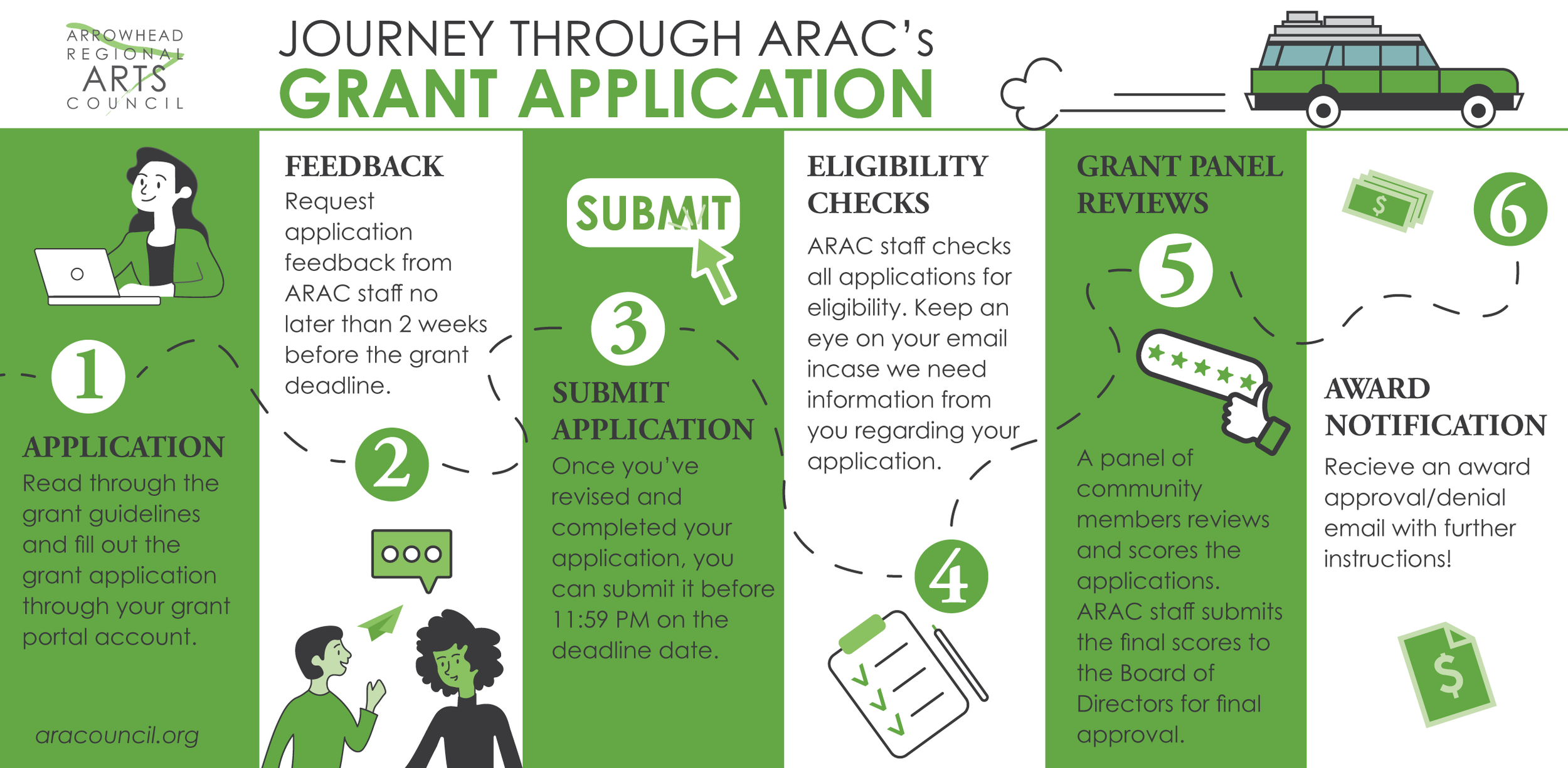
From application to award, the overall grant application process can take up to six months. If awarded, the grant project period from payment to project completion and final reporting typically takes place over a 12-18 month duration. Expect to be responsible for grant-related project production and reporting for over two years. Awardees are required to retain receipt and documentation of grant activities for up to three years after the grant period ends. Be prepared to embark on a 2-5 year artistic journey!
-
All applications will be made available on our website on the application open date and must be submitted via our secure online grants management system, Foundant.
If you don’t have access to a computer, you may arrange a time to use a computer at the ARAC offices or your local library.
-
ARAC Staff is available to assist applicants up to 10 business days before the application deadline.
For technical support, contact info@aracouncil.org.
For project proposal support, please submit a request here to connect with a Grant Advisor
Applications are only able to be reviewed by staff prior to submission. If requesting grant application review, please keep your application in draft mode for staff review
-
Applications close at 11:59 p.m. on the due date.
Submissions after the deadline will not be accepted.
Exceptions will only be made in very specific, rare circumstances. Any exception requests must be made in writing to grants@aracouncil.org as soon as possible after the application deadline for consideration
-
After the application deadline, applications will go into a 2-3 week Eligibility Review by ARAC Staff
During this time, applicants may receive emails from staff regarding technical issues, incomplete information, or eligibility-related questions.
After passing Eligibility Review, applications will move forward to Panel Review in order to provide recommendations to the ARAC Board of Directors for final approval
-
Reviewers will have up to two weeks to review applications prior to Panel Review Sessions for final remarks and scoring.
Panelists use the following published Criteria to evaluate applications:
Artistic Vision
Impact
Ability
Evaluation
The ARAC Grant Review Panels are composed of artists, industry professionals, and other art enthusiasts from the Arrowhead Region. After reviewing assigned applications, small groups convene at Panel Review sessions to further discuss and score eligible applications based on the grant program criteria.
The final results are then tabulated by ARAC Staff, with the top-scoring proposals moving forward for recommendation to our Board of Directors for review and final approval at the next Quarterly Board Meeting.
If you would like to attend your review panel meeting, please reach out to info@aracouncil.org within 2 weeks of the application deadline.
Attending the review panel meeting is optional for applicants. In lieu of attending, you can always reach out to ARAC Staff for feedback on your application and/or notes from the Review Panel for reference by requesting Grant Advisement here.
Grant funds will be allocated based on reviewers’ scores and the maximum three (3) additional priority percentage points to create a final score. The three (3) categories eligible for these points are:
First Time Applicant
BIPOC, LGBTQAI+, Applicants with Disabilities, U.S. Military Veterans, and/or Age 65+ Applicants
Rural Applicants from a County or Town that has received less than 2 ARAC Grants in the last Fiscal Year
-
After final Panel recommendations are reviewed and approved by the ARAC Board of Directors at their quarterly board meeting, all eligible applicants will receive an Award Approval or Denial Notice via email within a week of the board meeting decision date.
To officially accept the award, grantees will be issued required follow-up form(s) within their Grant Portal to complete promptly before payment can be issued. Once complete, the grant award payment will be issued in the full amount requested.
After accepting, awardees can expect payment the month prior to the grant period start date.
Failure to respond or accept the award within the acceptance period could result in the loss of funding.
Please monitor your email for official correspondence throughout the application period.
ARAC will publicly announce the awarded grantees within the month following the quarterly board meeting, ideally prior to the grant period start date. Please join us in celebrating the announcement at this time. Follow along @aracouncil on social or sign up for our newsletter to learn more about all things art in our community!
ARAC’s FUNDING SOURCE
Arrowhead Regional Arts Council grants are made possible in part through appropriations from the Minnesota State Legislature with money from the State General Fund and the Arts and Cultural Heritage Fund of the Legacy Amendment, as well as generous support from the McKnight Foundation.
In 2008, Minnesota voters passed a constitutional amendment creating a new 3/8-cent sales tax to support outdoor heritage, clean waters, sustainable drinking water, parks and trails, arts, history, and cultural heritage projects and activities. This amendment is called the Clean Water, Land, and Legacy Amendment. Of the total proceeds from the sales tax, 19.75% are dedicated to the Arts and Cultural Heritage Fund (ACHF). Proceeds are intended for “arts, arts education, arts access, and to preserve Minnesota’s history and cultural heritage.” A large amount of that funding has been allocated to the Minnesota State Arts Board and 11 regional arts councils across the state, including the Arrowhead Regional Arts Council.
ACHF programming must be rooted in principles that guarantee the greatest positive impact with as many Minnesotans as possible and lead to the kind of social, cultural, and economic development outlined in this vision. These principles are intended to inform decisions made by the Legislature regarding the disbursement of the overall fund. Funding decisions, both at the appropriations level as well as at the grant-making level, will respect the constitutional requirement that ACHF funds not be a substitute for traditional sources of funding, including public operating and capital funds, both state and local. You can find more information on ACHF’s 25-Year plan here.
ART ADVOCACY
To advocate for the arts and this critical funding, consider becoming a member of Minnesota Citizens for the Arts or joining ARAC annually at Arts Advocacy Day in St.Paul! Organized in 1974, MCA is the oldest continuously operating statewide arts advocacy organization in the country.
As one of the nation’s leading advocacy groups for the arts, MCA has been organizing the creative community for decades to protect and defend this essential State funding for the arts. Thanks to their work alongside arts advocates at the State Capitol, critical funding remains secure for Minnesotans to have access to and involvement in the arts. Learn more about their mission here.